

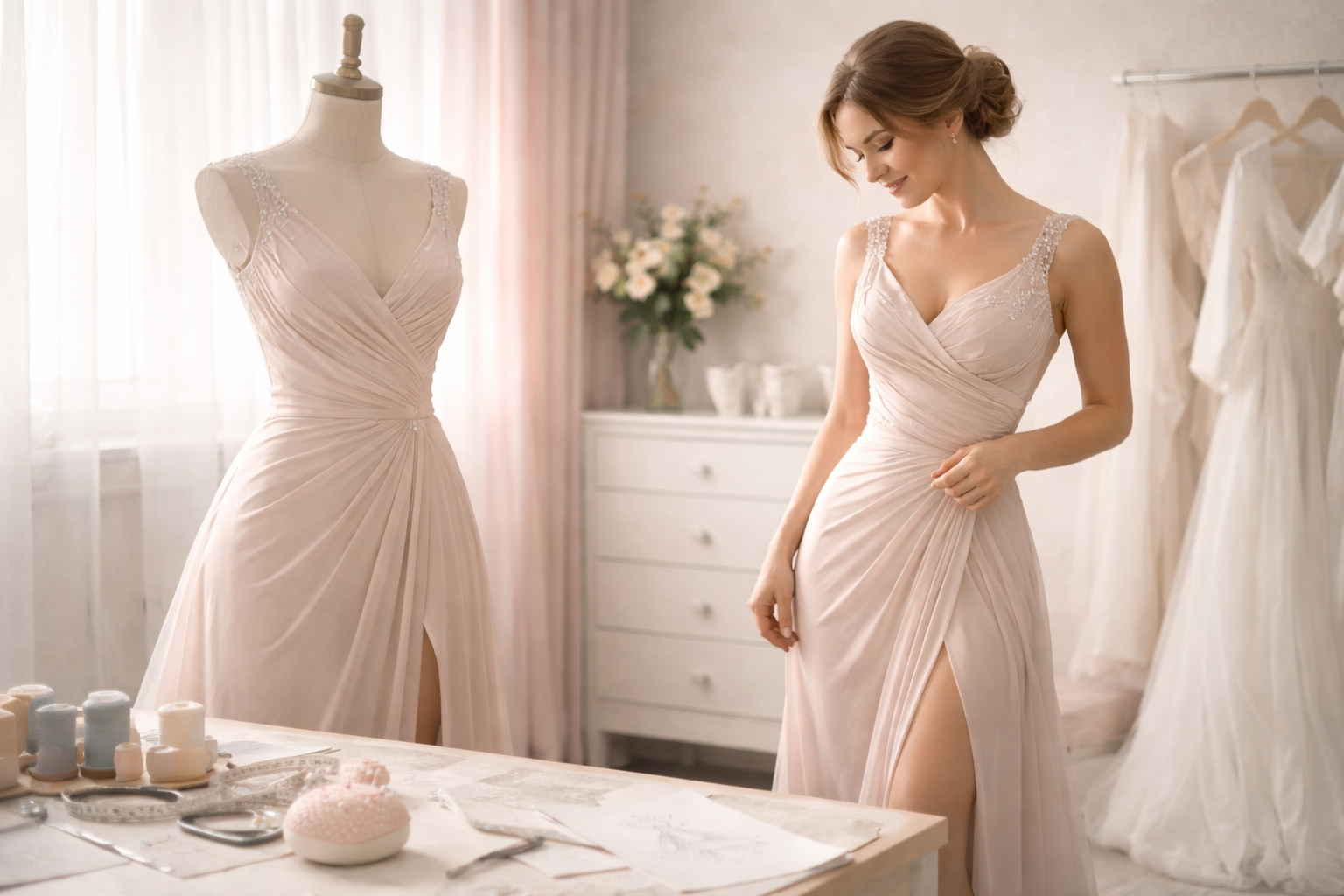
Why Dresses Look Different on You Than on the Mannequin
You find the perfect dress on a mannequin. The silhouette looks stunning. The fabric drapes beautifully. You take it to the fitting room with excitement. Then you try it on, and the disappointment hits.
The dress that looked flawless on display now pulls in the wrong places, gaps where it should fit, and creates a silhouette nothing like what you saw. This experience happens to nearly every woman, regardless of size or shape.
This guide explains exactly why dresses look different on mannequins than on your body—and how custom dresses eliminate this frustration.
At Zyvanea, we have helped thousands of women understand why ready-made clothing fails them. The problem is not your body. The problem is clothing designed for bodies that do not exist.
What This Guide Covers
- Why Mannequins Create Unrealistic Expectations
- The Truth About Mannequin Proportions
- Body Shape and How It Affects Dress Fit
- Fabric Behavior on Static vs Moving Bodies
- Height, Posture, and Weight Distribution
- Store Styling Tricks You Should Know
- How Custom Dresses Solve This Problem
- Real Transformation Stories
- Frequently Asked Questions
Why Mannequins Create Unrealistic Dress Expectations
Mannequins are marketing tools. They exist to sell clothing, not to represent real bodies. Understanding this distinction changes how you interpret what you see in stores.
Retail displays are carefully constructed to create desire. The dress on the mannequin represents an idealized version of how that garment could look under perfect conditions. Those conditions rarely exist in real life.
Visual merchandising teams spend hours positioning each mannequin, adjusting each garment, and lighting each display. The goal is aspiration, making you believe you will look exactly like that mannequin when you purchase the dress.
The fitting room experience differs dramatically from the showroom. Different lighting, no styling tricks, and your actual body replace the manufactured perfection of the display. This gap between expectation and reality causes frustration that has nothing to do with your worth or beauty.
Do Mannequins Follow Real Human Body Proportions?
The short answer is no. Standard mannequins bear little resemblance to actual human bodies.
Mannequin proportions are deliberately exaggerated and unrealistic. They feature elongated limbs, impossibly narrow waists, and idealized curves that exist in perhaps 5% of the actual population.
Consider the numbers. Standard fashion mannequins stand 5 feet 10 inches to 6 feet tall. The average American woman stands 5 feet 4 inches. That six-to-eight-inch height difference alone changes how every dress proportion appears.
| Feature | Standard Mannequin | Average US Woman |
|---|---|---|
| Height | 5'10" - 6'0" | 5'4" |
| Bust | 34" | 38.7" |
| Waist | 24" | 38.7" |
| Hips | 34" | 41.2" |
| Proportions | Elongated | Varied |
| Posture | Perfect static | Natural movement |
| Asymmetry | None | Common and normal |
Real bodies have curves in different places. Real bodies have one shoulder slightly higher than the other. Real bodies have natural asymmetries that make us human. Mannequins have none of these characteristics.
How Body Shape and Posture Affect Dress Appearance
Every body carries weight and curves differently. These variations dramatically impact how any dress looks when worn.
Body shapes are commonly categorized as apple, pear, hourglass, rectangle, and inverted triangle. Each shape interacts differently with fabric and cut. A dress designed with one body shape in mind will pull, gap, or hang incorrectly on a different shape.
Mannequins represent one standardized shape only. They cannot account for the beautiful diversity of real human bodies.
| Body Shape | Common Fit Issues with Ready-Made |
|---|---|
| Apple | Waist tightness, hem riding up front |
| Pear | Hip restriction, waist gaping |
| Hourglass | Waist-hip ratio mismatch |
| Rectangle | Shapeless appearance, excess fabric |
| Inverted Triangle | Shoulder strain, hip looseness |
Posture adds another layer of complexity. Forward-rounded shoulders change how necklines sit. Lordosis, a curved lower back, affects waist fit and hem evenness. Even mild scoliosis creates uneven hemlines that no standard dress can accommodate.
Your natural stance differs from mannequin rigidity. Mannequins stand in one perfect, static position. You move, shift weight, and hold your body in ways unique to you.
How Fabric Behavior Changes From Mannequin to Moving Body
Mannequins are static objects. You are a dynamic, moving human being. This fundamental difference changes everything about how fabric behaves.
On a mannequin, fabric hangs in one fixed position. It never moves, shifts, or responds to motion. On your body, fabric reacts constantly to walking, sitting, reaching, bending, and breathing.
Gravity affects draping differently on curves. Fabric falls one way on a flat mannequin surface and entirely differently over bust, hip, or stomach curves. These phenomena cannot be predicted from a static display.
Body heat changes fabric behavior. Your warmth softens certain fabrics, causing them to relax and drape differently than in an air-conditioned store. This is especially noticeable with synthetic materials.
Mannequins also benefit from hidden manipulation. Retailers use pins, clips, and tape hidden behind mannequins to create smooth appearances. Fabric is pulled taut and secured. Excess material is folded away from view. None of these tricks works on a real, moving body.
How Height and Torso Length Change Dress Appearance
Dress proportions are designed for specific body dimensions. When your dimensions differ from design specifications, every element of the dress falls incorrectly.
Standard dress designs assume heights of 5 feet 6 inches to 5 feet 8 inches. If you are shorter or taller, waistlines hit wrong points, hemlines fall incorrectly, and decorative details appear misplaced.
Torso length variations compound these issues. Women with long torsos find that empire waistlines sit too high, at the bust rather than below it. Women with short torsos find that waist details hit their ribs rather than their natural waistline.
| Height/Torso Type | Common Issues |
|---|---|
| Petite | Hemlines too long, overwhelming proportions |
| Tall | Hemlines too short, waist hitting the wrong point |
| Long Torso | The Empire waist sits at the bust, not below |
| Short Torso | Waist details hit ribs, not waist |
These proportion issues exist before you even consider fit through bust, waist, and hips. Height and torso variations alone can make a beautiful dress look completely wrong.
How Weight Distribution Impacts Dress Fit and Draping
Two women wearing the same dress size can look entirely different in identical dresses. The reason is weight distribution, where your body carries volume.
Some women carry weight in their upper bodies. Others carry weight in their lower body. Some have fuller arms or wider backs. Each variation affects how the fabric drapes, clings, or gaps.
Mannequins have a uniform, idealized weight distribution. Real bodies do not. Your unique distribution pattern means that standard dresses designed for average distribution will always require compromise in fit.
Areas of concern vary dramatically from person to person. One woman needs extra room through the shoulders. Another needs ease through the hips. These individual requirements cannot be addressed by standardized sizing.
The Hidden Mannequin Advantages
What you see on a mannequin is a carefully constructed illusion. Lighting and styling techniques create flattering presentations that disappear in the fitting room.
- Strategic lighting hides fabric flaws and creates artificial contouring. Bright spots highlight positive features while shadows minimize problems.
- Behind every perfectly dressed mannequin, you will find styling secrets invisible to shoppers. Clips and pins pull fabric smooth. Tape secures necklines and hems in precise positions.
- Tissue paper stuffing creates shape where fabric would otherwise collapse.
- Mannequins are positioned at carefully chosen angles. You see only the most flattering view. The back, where many fit issues become apparent, faces away from customer sight lines.
What you see on a mannequin is a styled, pinned, lit, and photographed best-case scenario. It is not how the dress actually hangs on an unpinned, moving human body.
How Custom Dresses Solve This Problem
Custom dresses eliminate every issue described in this article. They begin with your body, not an idealized form.
When you order a custom dress, measurements capture your unique proportions. Your height, torso length, weight distribution, and posture inform every pattern decision. The dress is designed for bodies exactly like yours because it is designed from your actual body.
Design accounts for your specific body shape. Dart placement, seam positions, and fabric ease are calculated for your curves. The dress enhances your shape rather than fighting it.
Fabric is selected based on how it will behave on your body during your activities. Will you sit for hours? Dance all evening? Move freely at a conference? These considerations guide fabric and construction choices.
The fitting process refines fit directly on your body. Adjustments are made while you wear the dress, move in it, and experience it. No guessing. No hoping. No disappointment.
Ready-Made Reality
- Standardized sizing
- Generic proportions
- One shape fits all
- Static fit assumptions
- Requires alterations
Custom Dress Advantage
- Your exact measurements
- Your body proportions
- Designed for your shape
- Movement-tested fit
- Perfect from delivery
When Custom Dresses Outperform Every Mannequin
Case Study 1: The Petite Professional
Client: Danielle K., Accountant, Philadelphia
Frustration: At 5 feet 1 inch with a long torso, Danielle found that every dress overwhelmed her frame. Waistlines hit her ribs. Hemlines dragged.
Custom Solution: Zyvanea created professional dresses with proportions calculated specifically for her petite frame and unusual torso ratio.
Result: "For the first time, I looked in the mirror and saw clothes that belonged on MY body. Not clothes I was borrowing from someone taller."
Case Study 2: The Hourglass Challenge
Client: Christina M., Event Planner, Atlanta
Frustration: With a 12-inch difference between her waist and hips, Christina could never find dresses that fit both areas. Tight at the hips meant gaping at the waist.
Custom Solution: Our team designed dresses that celebrated her hourglass proportions instead of fighting them.
Result: "I used to dread events because I could never find dresses that fit properly. Now I actually look forward to getting dressed."
Case Study 3: The Posture Correction
Client: Margaret T., Professor, Boston
Frustration: Years of desk work gave Margaret forward-rounded shoulders. Every dress pulled at the back and gaped at the front neckline.
Custom Solution: Zyvanea adjusted pattern pieces to accommodate her natural posture, eliminating pulling and gaping entirely.
Result: "The designer noticed my posture in the first five minutes. No ready-made dress ever accounted for that. The difference is remarkable."
Real Women, Real Fit, Real Confidence
— Heather Morrison, San Diego, CA
— Lauren Mitchell, Phoenix, AZ
— Victoria Hayes, Nashville, TN
FAQs
Discover the Custom Difference
Stop settling for dresses designed for mannequins. Get dresses designed for YOU.
Book Your Consultation TodayReady to start your custom dress journey? Read our complete guide: Everything You Need to Know Before Getting Your First Custom Dress


